February 11th, 2016 the sail to Puerto Perme did not start out very good as the winds were blowing from the north, on the nose and the sea was confused…We had to tack into the wind and this proved to be more difficult than expected. We did not manage to move forward so that the coast guard from Sapzurro came to make sure we were not in trouble. We reassured them that we were OK and confirmed we were sailing to Panama over the radio. Once we were out of the zone with the confused seas we were fine although the waves were still high and the skies were grey. After 6 hours of sailing we were happy to arrive at Puerto Perme with a bit of blue skies. There was a Columbian supply boat already there and they were all amazed we arrived with this “mal tiempo”. We did not think it was that bad, but nevertheless were happy to anchor safely in the bay.
Guna Yala territory. We started all the way on the bottom of the map and sailed over a period of 2 weeks to Porvenir at the top of the map, which is about 100 miles.
The Guna Yala is an indigenous province in northeast Panama and is home to the Gunas (Indians). The capital of the province is Porvenir. An archipelago of 365 islands is around the coast, of which 36 are inhabited. They say, an island for each day of the year.
Guna Yala flag.The Revolution Flag from 1925 during which the Guna Indians fought the ruling Panamanian authorities, whom were attempting to force the Indians to adopt Hispanic culture by military action. During this revolution the Guna Yala territory seceded and operated as the short-lived Republic of Tule. Following mediation by the United States the Guna re-united with Panama. The Gunas with the support of the Panamanian government, created an autonomous territory called the Guna Yala district which they would rule themselves.The Gunas at the supply boat where they can get vegetables but also order chairs etc. from the mainland. This boat came from Columbia but there are also boats from Panama.A Guna family which came to visit on the boat. Unfortunately the girl did not wear their typical dress. They came to sell bananas, coconut and a bracelet.
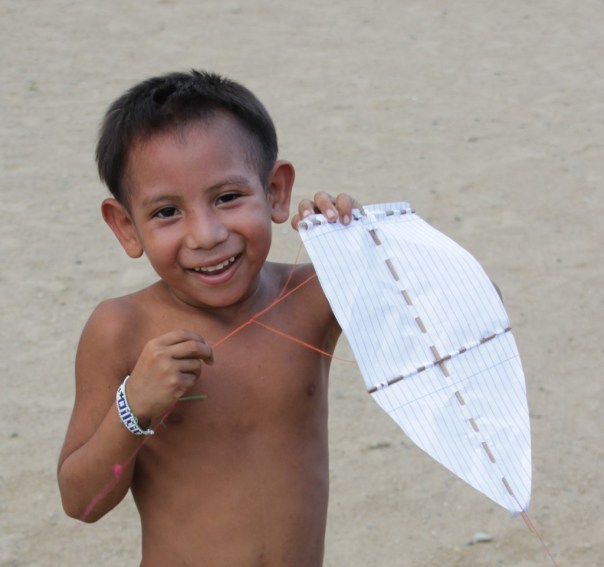
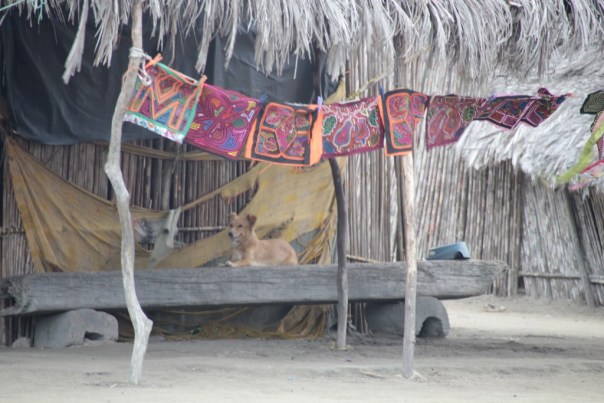
Typical Ulu, dug-out boat. The Gunas go everywhere with these in any weather !Collecting a 10 USD anchor fee. They first wanted 20 USD but during our visit of the village they had said 10 USD so we refused to pay the 20 USD. Stefan made good by giving fishing line and a hook. The women do not like to have their picture taken but here the man wanted the picture…The woman is wearing the typical mola (blouse) and a red scarf on their head. They have beads around their wrists and ankles.The streets in a typical Guna village. A lot of the houses have small solar panels (see in the back of the picture)Happy and proud with his homemade kite.Typical street in the Guna village.The villages were always clean and built with respect for nature.A lot of the Guna indians will have to move to the main land if the water level continues to rise. There are already moving plans for some islands.As a visitor you are not allowed to take any coconut as they all belong to someone. Even the ones on the ground cannot be taken.Gunas are very curious and when you arrive with your boat they always paddle their ulus to come and see.A Guna with plantains.Not always all happy faces. Big sister taking care of the little ones.A luxury toilet in stone instead of in wood, on isla Tigre.More typical village streets.Life is good in the Guna village. Definitely no stress here!A Guna flag and a revolutionary flag (with the swastika).The molas, form part of the traditional outfit of a Guna woman, two mola panels being incorporated as front and back panels in a blouse. In the Guna’s native language, “mola” means “shirt” or “clothing”. The mola originated with the tradition of Guna women painting their bodies with geometrical designs, using available natural colours; in later years these same designs were woven in cotton, and later still, sewn using cloth bought from the European settlers of Panamá. The price for a mola ranges from 10 USD to 60 USD.The full costume traditionally includes a patterned wrapped skirt (saburet), a red and yellow headscarf (musue), arm and leg beads (wini), a gold nose ring (olasu) and earrings in addition to the mola blouseNot all islands are inhabited. Although even on this small island, Corgidup, there was one hut ! Dup means island in Guna language.When we arrived in the Hollandes Cays the sun was finally out and the colours of blue were just incredible. Far away you can see the waves breaking on the reef. We anchored in crystal clear water !The Coco Banderas.With Cathi and Bill from Calgary, Canada enjoying a meal on the beach of Barbecue island (Morodup). We sailed together till Hollandes Cays and met them briefly in Shelter Bay Marina. They will have sailed around the world when they reach Calgary in July. They are now headed for Galapagos and Hawai. They had such great stories !Stefan with his Code Zero sail. So great when there is not a lot of wind. Hope to have more pictures when we sail the Pacific !Ready to check-in at Porvenir with all the boat documents, passports and cash dollars. For 2 people and a boat, 500 USD. We had to help out some french who thought they would be able to pay with Euros or credit card but only dollars are accepted in cash. Luckily we had enough USD left to change to EUR.
I really enjoyed the Guna Yala although I missed the blue skies from Colombia. It was very difficult to take pictures from the women in traditional dress as mostly they do not want you to take any pictures. Some will ask 5 USD to have their picture taken. I wonder if the Guna Indians will be able to keep to their strict traditions with more and more tourists visiting these villages. It is such a fine balance to profit from the tourist money but also to keep the youth interested in this remote life. The sailing was not always easy but we learned a lot about navigation through reefs which will help in French Polynesia.
We visited the following villages : Anchucunda, Carreto, Suledup, Mulatupu, Ustupu, Bahia de Gollondria (Alligandi), Niad, Isla Tigre, Tiadup, Hollandes Cays, Corgidup and Isla Porvenir. Next stop is Portobelo.
Today, Monday, February 29, 2016, We are in Shelter Bay Marina, Colon, Panama, right before the canal entry ! We left Santa Marta January 29th, a month passed by so quickly. I will try to give the highlights from this past month with lots of pictures.
We sailed from Puerto Velero to Cartagena on January 31,2016, anchor was up at 6.30 AM. We sailed about 10 hours and arrived at 4.20PM . It was great ! We had more tuna for dinner. Stefan had caught a tuna between Santa Marta and Barranquilla.
Stefan in a good mood (but missing a party) because we are finaly sailing again and we had a nice sail to Cartagena.View from the boat. Anchored just in front of Club Nautico with the city of Cartagena in the background.Leaving the harbour of Cartagena, on our way to the Islas Rosario.
Monday, February 1, 2016, we left Cartagena at 9.30AM and arrived in Peninsula de Baru at 1.40PM. Baru is part of Islas del Rosario. See below a map with the Rosarios.
On Tuesday February 2, 2016 we left Bari in the afternoon for Isla Grande. Only one hour later we arrived there.
The road on Isla Grande. No cars, only bycicles, donkeys or on foot.Shopping on Isla Grande. Typical street…The toilets are on the right. Plastic bottles are being used to decorate the walls of the toilets.
On Wednesday, February 3rd, 2016 we sailed to Tintipan Island part of the San Bernardo Archipelago.
Another beautiful anchorage at Tintipan…We arrived on the deserted beach and it was full with falcons.A couple tamed little parrots part of the local bar on the beach.On our way with the dinghy from Tintipan to Santo Cruz el Islote, beautiful scenery…Hostels built in the water. This must be paradise.Empty private summer home. There are 3 vacatiion periods in Colombia : Christmas, January and Semana Santa. During those periods all of these islands are full of vacationing Colombians.
Public telephone on Santa Cruz del Islote. No need to stand up the whole time 🙂Its significant population compared with its small size (approximately 0.012 km²) results in it being the most densely populated island on Earth!Streets on Santa Cruz del Islote.
On Thursday, February 4, 2016 we sailed for about 7 hours to arrive on Isla Fuerte at 5 PM. We were just anchored in a small bay lined with beautifull vacation homes when a motorboat approached us with 4 people on board. They wanted to know where we were from and if we wanted to have a drink and dinner with them ? They lived in one of the houses lining the bay. We hesitated at first, surprised with this nice invitation but agreed after we would first clean up ourselves :-). This is how we met Russ ( US) and Patricia (Colombian) and their friends (Joe and Sue ? ). We had such a great evening, and wat too much to drink !
Friday, February 5th, 2016, the next morning we were invited for breakfast and a tour of the island.
On our way to the beach through the centre of the island. No cars, no motorcyles, you can only get around with donkeys, bicycles or on foot. Really great.Town center.Patricia organised a massage on the beach for me. Does it get any better ? 🙂Russ (right) and Joe (left) visiting our boat, captain Stefan in the middle.Sue on the boat.Patricia, the perfect hostess !In the evening we were invited again, together with about 15 young people, who are renovating a hostel on the island, to have dinner and drinks. Russ and Patricia were perfect hosts. We had a wonderful time meeting all these people and Russ is a good cook.
After the party, Russ and Patricia wanted us to take all the food that was left after their 2 month stay in Colombia since they were leaving for the US the next morning. We went back to the boat happy and loaded with food, 2 large plastic bags ! Thanks so much Russ and Patricia !!!! We hope to see you both in Belgium.
Saturday, February 6th, 2016. We reanchored the boat a little further in calmer waters and had another nice walk on the island.
A good thing we cannot take a donkey on the boat, this baby one was so cute 🙂View from the boat.The hostel which the young people were renovating. Most of them were dutch but also some Australian and US guys.A great lunch on the beach with our feet in the sand and a nice breeze to stay cool. This is getting close to paradise 🙂
We left that night at 5.40PM to sail to Sapzurro, a nightsail of about 12 hours we had calculated. The sailing went so fast, with high waves that we arrived at 5 AM Sunday, February 7th, 2016 just before the bay of Sapzurro. Because it was still dark, we had to “park” the boat before the bay for 1.5hours. We were both so tired that we managed to sleep each about 30 minutes ! We sailed into the bay around 7.30 AM and were happy to drop the anchor and go to sleep :-). We were now still in Colombia but right on the border with Panama.






 I really enjoyed the Guna Yala although I missed the blue skies from Colombia. It was very difficult to take pictures from the women in traditional dress as mostly they do not want you to take any pictures. Some will ask 5 USD to have their picture taken. I wonder if the Guna Indians will be able to keep to their strict traditions with more and more tourists visiting these villages. It is such a fine balance to profit from the tourist money but also to keep the youth interested in this remote life. The sailing was not always easy but we learned a lot about navigation through reefs which will help in French Polynesia.


